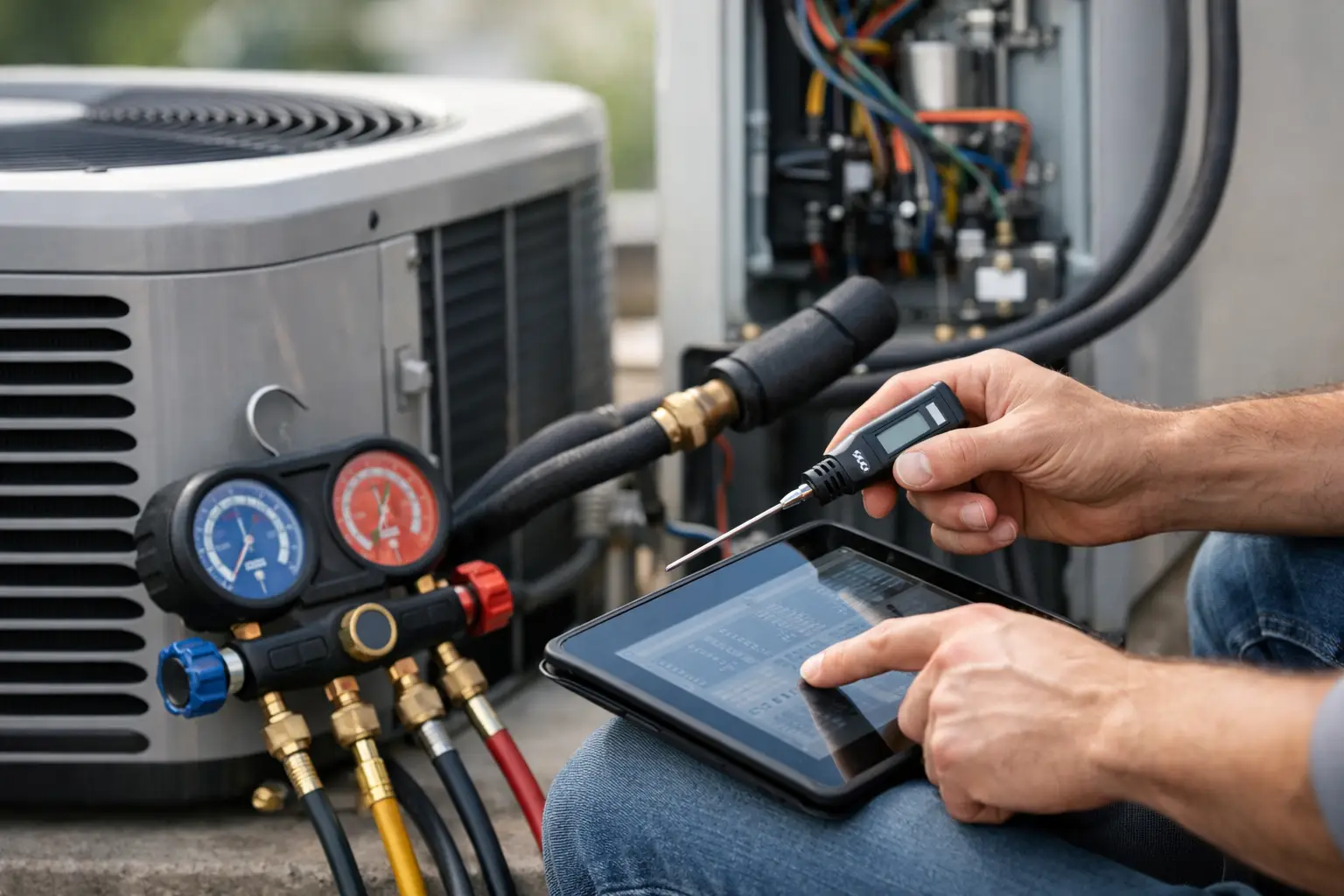
A suction pressure reading by itself does not tell you whether a system is charged correctly. A line temperature by itself does not tell you much either. An hvac superheat calculator online puts the two readings together, helping technicians turn field measurements into a usable diagnostic direction without digging through a long manual.
That matters when the call is waiting, the equipment is running under a real load, and the symptom could come from more than one issue. Superheat is not a replacement for system knowledge. It is a quick calculation that helps identify what the evaporator is doing with the refrigerant it receives.
What an HVAC Superheat Calculator Online Calculates
Actual superheat is the difference between the suction line temperature and the refrigerant's saturated suction temperature.
Actual superheat = measured suction line temperature - saturated suction temperature
For example, a technician measures a 54°F suction line. The suction pressure, converted through the correct pressure-temperature relationship for that refrigerant, shows a saturated temperature of 40°F. Actual superheat is 14°F.
An online calculator speeds up the math, but the pressure-temperature conversion is the real value. Enter the refrigerant, suction pressure, and measured suction line temperature. The calculator identifies the saturation temperature and returns the superheat result.
The calculation is simple. Getting dependable inputs is where good field practice matters. Use the refrigerant actually in the system, not a guess based on the equipment's age. Measure pressure at the appropriate suction-side service location. Take the line temperature on a clean section of suction line with a properly secured clamp. Insulate the temperature clamp from outdoor air when conditions can affect the reading.
A calculator can only work with the readings it receives. A loose temperature probe, a wrong refrigerant selection, or a gauge reading taken while the system is still stabilizing can create a clean-looking answer that sends the diagnosis in the wrong direction.
Actual Superheat and Target Superheat Are Different
Technicians often use the word superheat to mean two different things. Keeping them separate prevents unnecessary charging adjustments.
Actual superheat is what the system is doing right now. It comes from the suction pressure and suction line temperature.
Target superheat is a charging target, usually used on systems with a fixed metering device such as a piston or capillary tube. It is commonly determined from indoor return-air wet-bulb temperature and outdoor dry-bulb temperature, using the equipment manufacturer's charging chart or an approved calculation method.
An online superheat calculator may provide actual superheat only, target superheat only, or both. Know which result you are looking at before acting on it.
For a fixed-orifice system, compare actual superheat to the manufacturer-approved target after verifying airflow and operating conditions. If actual superheat is substantially above target, the evaporator may be underfed. Low refrigerant charge is one possibility, but not the only one. Low airflow, a restriction, a plugged filter-drier, a metering-device issue, or improper load conditions can also change the reading.
If actual superheat is substantially below target, the evaporator may be receiving too much refrigerant for the load or may not be boiling refrigerant off as expected. Overcharge is possible, but so are low load, high airflow, an oversized fixed metering device, or compressor problems.
On a TXV or EEV system, superheat is still a useful diagnostic reading, but it is not usually the primary charging method. Follow the manufacturer procedure. Many systems are charged by subcooling, weighed-in charge, or a specific commissioning process. Trying to force a TXV system to a generic target superheat can create a new problem while chasing the original one.
Take Readings That Are Worth Calculating
Before using an hvac superheat calculator online, let the system run long enough to stabilize under normal operating conditions. There is no universal wait time. A small residential split system may settle quickly, while a system with staging, variable capacity, a warm building, or recent repairs may need more time.
Confirm the basics before deciding a charge is wrong. Check the air filter, blower operation, return and supply restrictions, indoor coil condition, and outdoor coil condition. Verify that registers, dampers, and access panels are in normal positions. Airflow problems can look like refrigerant problems, especially when the only data collected is pressure and temperature.
Then collect readings in an organized order:
- Identify the refrigerant from the equipment data plate and service history.
- Measure suction pressure with instruments rated for the refrigerant and expected operating range.
- Measure suction line temperature near the evaporator outlet when evaluating evaporator superheat, unless the manufacturer specifies another location.
- Record indoor return-air wet bulb and outdoor dry bulb when checking target superheat on a fixed-metering system.
- Record liquid pressure, liquid line temperature, and subcooling when the charging procedure calls for them.
The point is not to create paperwork. It is to avoid a diagnosis based on one isolated number. A technician who records the conditions can explain why a reading makes sense, why it does not, and what should be checked next.
Read the Result in Context
A superheat result does not label a failed part. It narrows the problem-solving path.
High superheat can indicate a starved evaporator. Start by asking whether the evaporator has sufficient load and airflow. If airflow is correct, look at refrigerant charge, restrictions, metering-device operation, and liquid feed conditions. Compare suction pressure, head pressure, subcooling, temperature splits, and frost patterns. A restricted metering device and an undercharged system can both show high superheat, but the rest of the operating data will not usually match.
Low superheat can indicate that refrigerant is leaving the evaporator with little temperature rise. On a fixed-orifice system, compare it to target superheat and evaluate charge only after airflow is verified. On a TXV system, investigate bulb mounting, equalizer condition, valve response, load, and compressor performance as appropriate. Very low superheat can create a floodback risk, but the cause must be identified before making a correction.
Also account for where measurements are taken. Superheat measured at the evaporator outlet will differ from superheat measured at the condensing unit because the suction line gains heat along the way. Both values can be useful, but they answer different questions. Label the location in your notes so the next technician is not comparing unlike readings.
When an Online Calculator Helps Most
A calculator is especially useful when a technician needs a quick check while moving between equipment types and refrigerants. It reduces mental math, avoids reaching for a separate pressure-temperature chart, and creates a consistent process for newer technicians.
It also supports better communication. Instead of saying, "Suction looked low," a technician can document that the system had 31°F saturated suction, 52°F suction line temperature at the evaporator outlet, and 21°F actual superheat. That gives a service manager or another technician something concrete to evaluate.
For teams, consistency is often more valuable than speed alone. When everyone records the same core measurements, recurring failures become easier to spot. The conversation shifts from opinions to operating conditions.
HVAC Assist Pro is built around that practical need: giving technicians diagnostic tools, guided information, and a place to preserve field knowledge without hunting through disconnected notes and manuals. A calculator is one part of the process. The value comes from pairing the result with a repeatable diagnostic method.
Avoid the Common Shortcuts
Do not use a generic target superheat value because it worked on another system. Target values depend on indoor and outdoor conditions, equipment design, and manufacturer guidance. Do not add refrigerant solely because suction pressure appears low. Pressure changes with load, airflow, refrigerant type, outdoor conditions, and system configuration.
Do not treat a calculator result as permission to skip leak inspection, airflow checks, or electrical testing. If charge is low, determine why before adding refrigerant. If the system has a restriction, adding refrigerant will not remove it. If airflow is low, correcting the charge first can hide the actual problem.
Finally, use current refrigerant data and appropriate instruments. Refrigerant blends, glide considerations, and manufacturer specifications affect how saturation temperature should be interpreted. Follow the equipment instructions and applicable safety requirements.
A fast calculation is useful when it leads to the next right check. Take accurate readings, identify whether you need actual or target superheat, and let the full operating picture guide the repair.