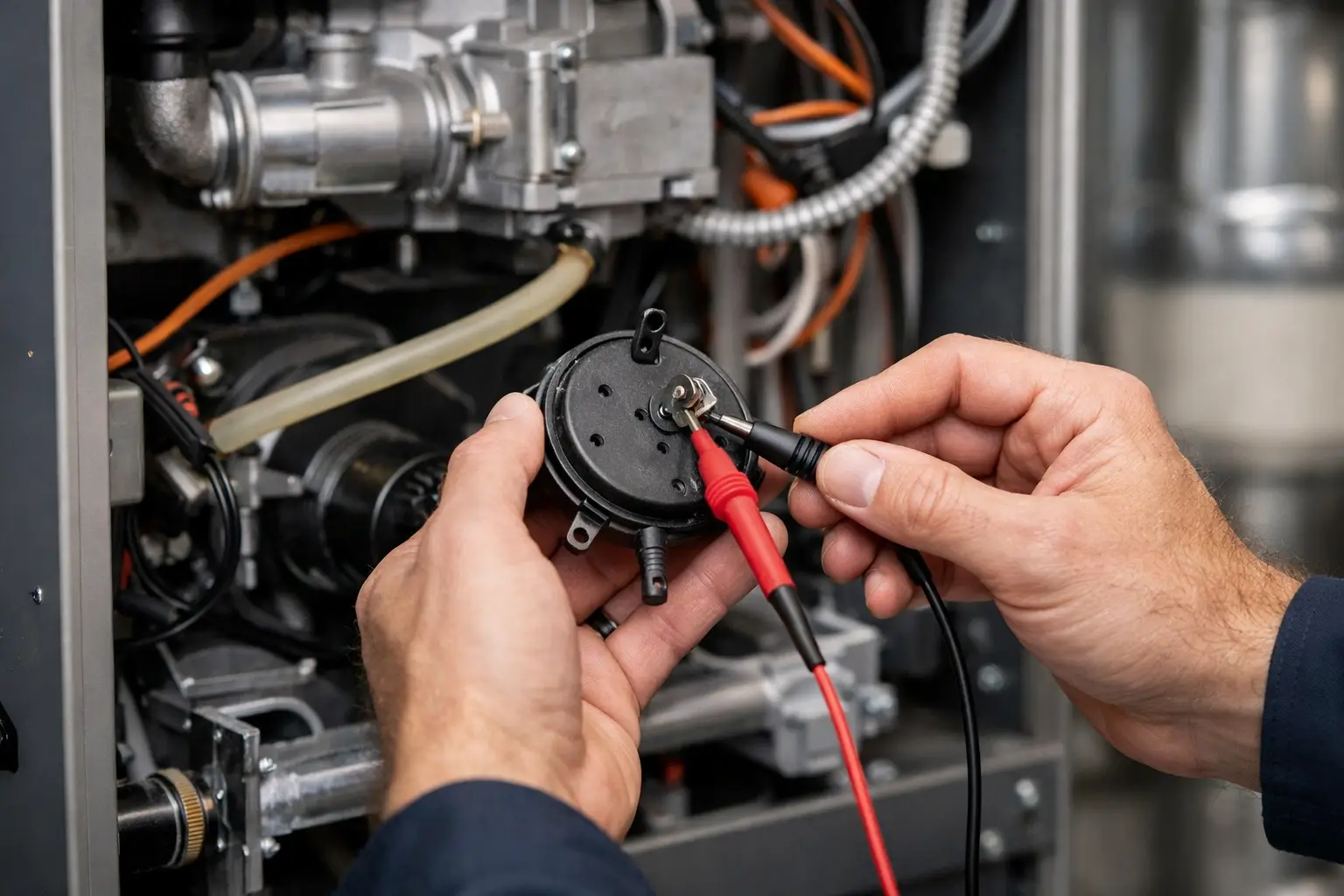
A furnace that starts its inducer, then stops before ignition, often gets labeled a bad pressure switch. That diagnosis is frequently wrong. The pressure switch is a safety proving device, and when it stays open, it may be reporting a real draft, venting, condensate, or combustion-air problem. Knowing how to troubleshoot furnace pressure switches means proving the conditions around the switch before replacing it.
For a service technician, this is a sequence problem. Verify the call, observe the startup cycle, test the circuit, then find out why the required pressure is missing. Do not bypass or jumper a pressure switch to make a furnace run. That can defeat a safety circuit designed to prevent unsafe venting or combustion conditions.
Understand What the Pressure Switch Is Proving
On a typical induced-draft furnace, the control board energizes the inducer motor after receiving a call for heat. The inducer establishes negative pressure in the collector box or inducer housing. That pressure closes the switch contacts, allowing the board to continue the ignition sequence.
A single-stage furnace commonly uses one pressure switch. Two-stage and condensing equipment may use multiple switches, or a dual-pressure switch with separate ratings. The label on the switch matters. It may show a negative pressure rating in inches of water column, such as -0.70 in. wc. That is not a recommended replacement guess. It is the pressure required for that specific switch to close.
The switch itself has only a few basic failure modes: damaged diaphragm, weak internal spring, stuck contacts, cracked housing, blocked pressure port, or electrical terminal failure. But an open switch can also result from a restricted vent, weak inducer, plugged condensate trap, sagging vent connector, blocked intake, split tubing, or water in the pressure circuit. The diagnostic job is separating a failed switch from a system that cannot create proper draft.
Start With the Furnace Sequence and Fault Code
Before disconnecting anything, run a normal heat call and watch the sequence. Does the inducer start? Does it sound normal? Does the pressure switch close before the igniter begins its warmup? Does the board display a pressure-switch code immediately, or only after a retry?
Read the furnace wiring diagram and the diagnostic legend on the blower door. Error codes are useful direction, but they are not a final diagnosis. A pressure-switch code may mean the switch was open when it should have closed, closed when it should have opened, or changed state at the wrong time. Those are different failures.
Check whether the pressure switch is open before the inducer starts. On most furnaces, that is the normal resting condition. If it is already closed before the call for heat, the board may lock out. Look for welded contacts, a pinched hose creating residual vacuum, incorrect tubing connections, or a switch that has been replaced with the wrong part.
Inspect the Easy Failures First
Turn off power to the furnace before handling wiring or removing access panels. Once the unit is safe to inspect, look closely at the pressure tubing and its connection points. A tube can look acceptable from a distance and still have a small split at the end, softened rubber, internal water, or a loose fit at the port.
Check the pressure port on the inducer assembly or collector box. Rust scale, debris, insect nests, and condensate residue can block the small opening. Clean the port carefully without enlarging it or pushing debris into the housing. Also inspect any tee fittings and secondary ports on furnaces with more than one switch.
On condensing furnaces, give special attention to the condensate system. A blocked trap, blocked drain line, improperly primed trap, or backed-up secondary heat exchanger can interfere with the pressure signal. Water can also collect in low spots in the tubing. If tubing routes downhill, gets kinked behind a panel, or has been installed incorrectly after a prior repair, it can create a repeat pressure-switch complaint.
Outside, inspect the vent and combustion-air termination. Snow, leaves, nests, mulch, ice, damaged screens, and incorrect termination clearances can restrict airflow. A furnace may operate normally in mild weather and fail during wind, freezing rain, or heavy snow. Ask when the issue occurs, not just whether it occurs.
Test the Pressure Switch Circuit Correctly
With the furnace calling for heat and the inducer operating, use a meter to verify the electrical state of the switch. The exact terminal arrangement varies, so follow the wiring diagram. In general, an open pressure switch will show voltage across its terminals when the control is attempting to energize the circuit. Once the switch closes, voltage across the closed contacts should drop close to zero.
A continuity test is useful only with power removed and wires isolated as needed. It confirms whether contacts are open or closed at that moment, but it does not prove the switch closes at the correct pressure. For that, use a manometer.
A digital manometer is the most reliable field tool for this diagnosis. Connect it to the appropriate pressure source using a tee so the switch remains connected and the furnace can operate normally. Compare the measured negative pressure during inducer operation to the rating on the pressure-switch label.
If the furnace creates more negative pressure than the switch rating and the switch remains open, the switch or its tubing connection is suspect. If measured pressure is below the rating, do not replace the switch first. Find the reason draft is inadequate.
There is some nuance here. A reading that barely meets the switch rating may still cause intermittent operation. Pressure can change as the furnace cabinet is installed, the blower starts, wind affects the termination, or condensate moves through the drain system. A furnace operating at the edge of the switch rating has a root-cause issue worth correcting.
How to Troubleshoot Furnace Pressure Switches With a Manometer
A manometer turns this from a parts-changing call into a documented diagnosis. Test the pressure where the switch sees it, not only at a convenient nearby point. On a condensing furnace, readings at the inducer, collector box, and pressure tube can differ when there is a restriction in a port or hose.
If pressure is low, work through the airflow path. Verify inducer wheel condition and motor operation. Inspect vent pipe sizing, slope, length, fittings, and signs of water accumulation. Check the intake pipe if the furnace uses direct venting. Confirm drains and traps are clear and correctly routed. Inspect the heat exchanger and collector areas when the furnace design allows proper access.
If pressure is good at the source but low at the switch hose, the restriction is between those points. A plugged port or water-filled tube is a common answer. If pressure at the switch is good and the contacts do not close, replace the switch with the exact approved part number or an approved equivalent matching the original specifications.
Avoid testing by sucking on the hose or applying uncontrolled shop air. Moisture from breath can enter the switch, and excessive positive pressure can damage a diaphragm. A hand vacuum pump with a gauge may be appropriate for a controlled bench check when the manufacturer procedure supports it, but an operating manometer test usually tells the more useful story.
Check for Problems That Mimic a Bad Switch
Some failures appear to be pressure-switch problems because the board never sees a stable closed circuit. Loose spade terminals, rubbed wires, corroded connectors, and poor board connections can interrupt the signal. Lightly tug on terminals with power off and inspect for heat damage or weak crimping.
A weak inducer can be deceptive. It may spin and still fail to create enough negative pressure under load. Listen for bearing noise, rubbing, or surging. Verify inducer voltage and inspect the wheel for debris. On equipment using a variable-speed inducer, confirm the board is commanding the correct speed and that the motor feedback system is functioning as designed.
Improper replacement parts create another avoidable problem. A switch with a similar appearance but different pressure rating may close too early, fail to close, or create nuisance lockouts. Transfer tubing carefully when replacing a switch, and confirm each hose returns to the correct port. On multi-switch furnaces, reversed tubes can produce confusing error codes.
Document the Fix Before Leaving
A complete service note should state the fault code, sequence observed, pressure-switch rating, actual manometer reading, condition of tubing and ports, and the repair performed. That record helps the next technician avoid repeating the same basic checks if the issue returns.
For teams, this is the kind of field knowledge worth saving in a shared diagnostic workspace such as HVAC Assist Pro. A photo of the pressure-switch label, a measured reading, and the actual restriction found can turn a difficult future call into a faster repair.
After the repair, cycle the furnace through multiple heat calls and reinstall all panels. Confirm ignition, flame proving, blower operation, and normal shutdown. A pressure switch is not an obstacle to get around. It is a clear signal to verify that the furnace can vent safely, and a careful measurement is usually the fastest path to the real problem.